All you need to streamline customer orders
Move beyond fragmented order-entry channels and manual workarounds. dCommerce provides a unified, high-precision connection between your customer-facing touchpoints and your back-office ERP. Centralise your orders, maintain data integrity, and scale your operations without increasing headcount.
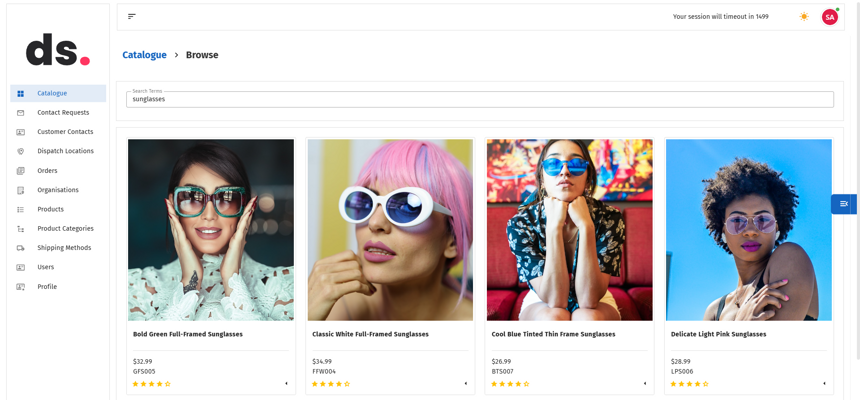
A platform that connects it all together
Most e-commerce platforms work well for simple transactions but struggle with the complexity of B2B sales. As your business grows, your order channels multiply, and your order complexity increases. dCommerce simplifies the process of synchronising data between multiple customer-facing touchpoints and your back-end ERP, whilst providing a central point of administration.
Multiple entry points
dCommerce provides multiple synchronisation streams to manage data transfer from upstream order-entry channels, such as mobile applications, storefront websites, and legacy integrations, eliminating the need for manual data entry and disparate processes.
Centralised administration
The central administration hub enables users to configure product data that isn't natively stored in the ERP, and to screen orders and resolve errors before they enter the ERP. Customer user access with restricted permissions enables a customer portal feature.
Real-time integration
Data transfer happens in near real-time through a dedicated synchronisation engine that handles routine data exchange and user-driven events. Automated data transfer reduces processing time and data entry errors by a considerable amount compared to manual processes.
Consolidate multiple channels into a single data flow
Whether it’s a modern API call, a legacy EDI file, or a manual CSV upload from a sales rep, every order is ingested into a single, searchable queue.
| Input Type | Supported Channels & Formats | Ideal For |
|---|---|---|
| Existing Digital Stores | Shopify, WooCommerce, Custom APIs | Brands with established B2C/B2B storefronts. |
| Document & File Automation | Automated SFTP (CSV/Excel), Email Scraping | Traditional clients sending legacy spreadsheets. |
| Direct Core Data | Database Sync, Native API Endpoints | Automated, machine-to-machine ordering. |
| Turnkey Front-Ends | Native dCommerce Storefront & Customer Portal | Clients requiring a ready-made, white-label digital presence. |
Essential B2B features
dCommerce is built upon the core capabilities that enterprise B2B organisations expect to run their day-to-day operations. But our platform is constantly evolving. We continually strive to introduce new features that keep your data pipeline running smoothly.
- Custom brandingTailor the user experience to match your corporate identity by applying your company logo, custom colour palettes, and brand assets to create a professional, white-labeled front-end for your buyers.
- Multiple customer users per customer accountSupport complex corporate structures natively. Allow your B2B customers to create multiple individual sub-users under a single Organisation account.
- Merchandise groupsOrganise your catalogue to reflect your physical operations. Group products by physical traits, consumer buying habits, or target audience. An alternative to hierarchical product categories.
- Customer-specific pricingExtend your default price book with customer-specific contract pricing.
- Flexible price visibilityOperate a hidden or quote-only product catalogue if required. You can completely hide product pricing from the public front-end, relying instead on pre-negotiated customer contracts that route directly to backend invoicing.
- Product restrictionsControl who can buy which products. Restrict visibility and purchasing of specific products to designated customer accounts, mirroring your offline distribution agreements.
- Batched ordersStreamline complex logistics by splitting a single order into multiple processing batches. Customers can route line items to different distribution points, warehouses, or delivery schedules within a single checkout flow.
- Flexible order quantitiesEnforce strict commercial purchasing rules at the checkout level. Set precise minimum order quantities (MOQs) or require buyers to purchase items in specified packaging multiples (e.g., box, crate, or pallet quantities).
Choose a platform that fits the way you really do business
B2B ordering is complex, and your systems should support rather than restrict your operations.
dCommerce accommodates customer-specific pricing, product access rules, complex order structures, and purchasing constraints to ensure alignment with real-world processes.
The platform provides the depth and flexibility required to deliver a professional, consistent ordering experience for your customers while maintaining structured, controlled internal operations aligned with best-practice workflows.
dCommerce accommodates customer-specific pricing, product access rules, complex order structures, and purchasing constraints to ensure alignment with real-world processes.
The platform provides the depth and flexibility required to deliver a professional, consistent ordering experience for your customers while maintaining structured, controlled internal operations aligned with best-practice workflows.
Multiple deployment options
The dCommerce platform is designed to meet the needs of businesses of all sizes and technical maturity. Whether you're running a lean, spreadsheet-driven operation or a complex, multi-site enterprise, dCommerce has a deployment option to match your precise architectural needs.
- StandaloneEngineered for growing businesses that require a centralised order management system, without the immediate need for ERP integration. In Standalone mode, dCommerce provides the central Administrative Hub for your system users and Customer Portal access for your customers.
- Multi-ChannelBuilt for organisations that collect orders from a range of input channels, a Multi-Channel deployment extends Standalone mode by enabling the synchronising of data from a range of order entry touchpoints - such as storefront websites, mobile apps, automated SFTP spreadsheets, and legacy email orders - directly into the Administrative Hub, providing a single point of administration for incoming orders.
- EnterpriseFor end-to-end order management, Enterprise mode is ideally suited to established businesses seeking absolute automation of order data. An Enterprise deployment extends the features of Multi-Channel mode by enabling ERP integration and eliminating manual data entry entirely. Customer and Product data are synchronised out to the Administrative Hub and onto the enabled order entry touchpoints. In return, order data is synchronised directly into the ERP.
- Enterprise PlusFor high complexity and full isolation, Enterprise Plus provides your business with a completely isolated, single-tenant cloud environment to guarantee the utmost control and compliance. Furthermore, this tier opens the door to our DS Digital Services stream, allowing us to build bespoke integration endpoints, custom validation rules, and specialised workflows tailored to your unique operational requirements.
Flexible where it matters. Structured where it counts
dCommerce offers multiple deployment pathways to meet your current needs and support future growth.
From focused standalone implementations to fully integrated enterprise environments, each option builds on a consistent foundation that enables expansion without disruption.
Flexibility is introduced deliberately within a structured, best-practice framework to ensure your system remains maintainable, aligned, and fit for purpose as complexity increases.
As your operations evolve, your architecture evolves with them, without requiring replatforming or unnecessary customisation.
From focused standalone implementations to fully integrated enterprise environments, each option builds on a consistent foundation that enables expansion without disruption.
Flexibility is introduced deliberately within a structured, best-practice framework to ensure your system remains maintainable, aligned, and fit for purpose as complexity increases.
As your operations evolve, your architecture evolves with them, without requiring replatforming or unnecessary customisation.
Got a unique workflow or a complex ERP configuration?
We understand that every B2B operation has distinct business rules, legacy workflows, and ERP requirements. Schedule a technical discovery call to learn how dCommerce can streamline your operations.